Your connector catalog is no longer your moat
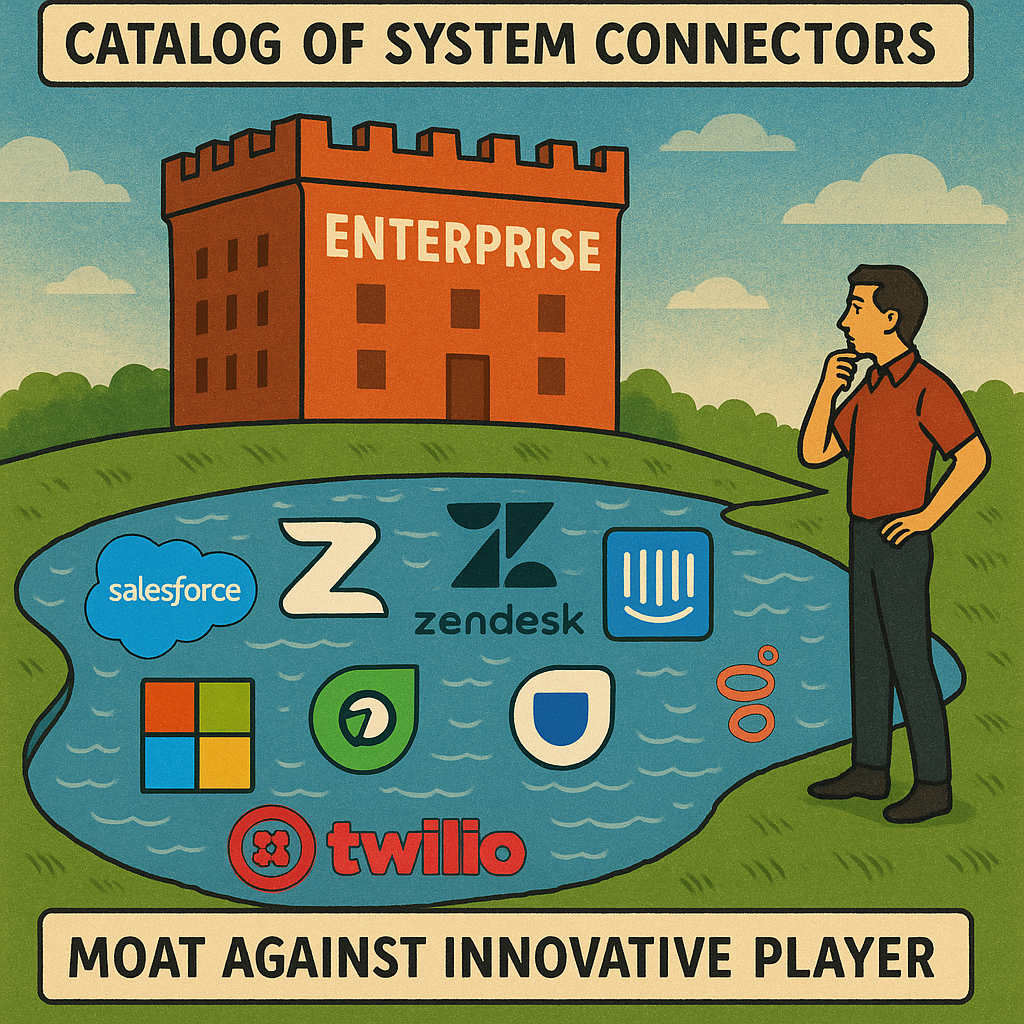
For too long, established software vendors and industry incumbents have jealously guarded their territory by boasting about the extensive catalogs of integrations they offered. Whether it was a…
For too long, established software vendors and industry incumbents have jealously guarded their territory by boasting about the extensive catalogs of integrations they offered. Whether it was a Customer Data Platform touting connections to every major marketing tool or a travel tech giant highlighting links to GDS and airline-specific platforms, the message was clear: our intricate web of integrations is a moat, an investment so significant it cannot be easily replicated, ensuring a superior, albeit often incomplete, experience.
In the travel and hospitality sector, this “integration moat” has been a particularly effective barrier for established, consolidated players with deep-rooted connections to legacy systems and industry-specific organizations. It has stifled innovation, making it incredibly difficult for newcomers to offer seamless services to airlines and hotel chains. This artificial complexity has, for years, protected the revenue streams of these incumbents.
Fortunately, the landscape is shifting dramatically. We believe that customers in these industries are on the cusp of experiencing a wealth of new choices. This change, like so many others in technology, is being driven by the rise of powerful language models like ChatGPT. Their proficiency in understanding and manipulating language extends remarkably well to the realm of data mapping and transformation — the very foundation of system integration.
Consider the seemingly simple task of converting a CSV file into an API request or transforming flat records for import into a database. These are the kinds of basic yet crucial transformations that historically required skilled, six-figure engineers to write often repetitive boilerplate code. This need fueled the growth of platforms like MuleSoft, aiming to simplify system integration. Yet, the integration industry remains a staggering $1 trillion market, a testament to the sheer volume of bespoke integration work required to connect disparate systems.
At HyperTrail, we believe that this entire segment of the industry is about to face a serious challenge, thanks to the native capabilities of modern large language models. Within our own HyperTrail platform, we’ve developed a “generative connector” technology. This allows users to connect virtually any two systems in mere minutes by simply describing the systems and providing a few examples of the desired data mapping and transformation rules. The language model then generates the necessary code.
But HyperTrail’s generative connectors go beyond simple code creation. They are designed to be “living” integrations, incorporating a feedback mechanism that monitors for errors and transformation issues. Users can then feed these errors back into the generation process, allowing the connector to iteratively refine and improve itself.
We are entering an era where integrating two systems will become as simple as a few clicks. The long-cultivated advantage of companies with vast integration catalogs is rapidly eroding. Having spent years navigating these catalogs in the customer experience space, we’ve often felt that the advertised capabilities were not entirely transparent. While vendors might list numerous integrations, the reality often involved complex configurations and limitations, meaning that not every use case was truly supported. Customers often ended up disappointed when the promised seamless integration failed to deliver the expected functionality.
This is another significant advantage of language models replacing the catalog approach. It allows for more seamless and faster integration, eliminating the often misleading claims of pre-built connectors.
The other common approach championed by incumbents has been the “build your own” integration platform, where companies like Tray.io position themselves as universal connectors, allowing users to visually design integrations using flows and scripting. While offering more transparency than a static catalog, the “build your own” approach often leads to complex, unwieldy constructs that ultimately require engineers to understand and maintain, negating the initial promise of a simple UI-driven solution.
This “build your own” paradigm is also being challenged by the rise of language models. Just as LLMs can generate the code for a connector, they can also potentially maintain and adapt that code based on ongoing prompts and evolving system requirements.
While AI-powered code generation is still in its early stages, particularly for complex, production-ready enterprise integrations, HyperTrail is demonstrating its immediate potential. Our generative connectors are already capable of effectively mapping and deploying transformations between complex industry systems, based on user input and examples, in a matter of minutes.
This marks the beginning of the end for the trillion-dollar system integration market as we know it, and the dawn of a new era for our customers. The ease with which systems will be able to connect will unlock a new wave of opportunities for brands to create incredibly sophisticated and interconnected experiences across all their systems — a future that we at HyperTrail firmly believe is the true trajectory of travel and consumer experience.