Why Visual Workflows suck.
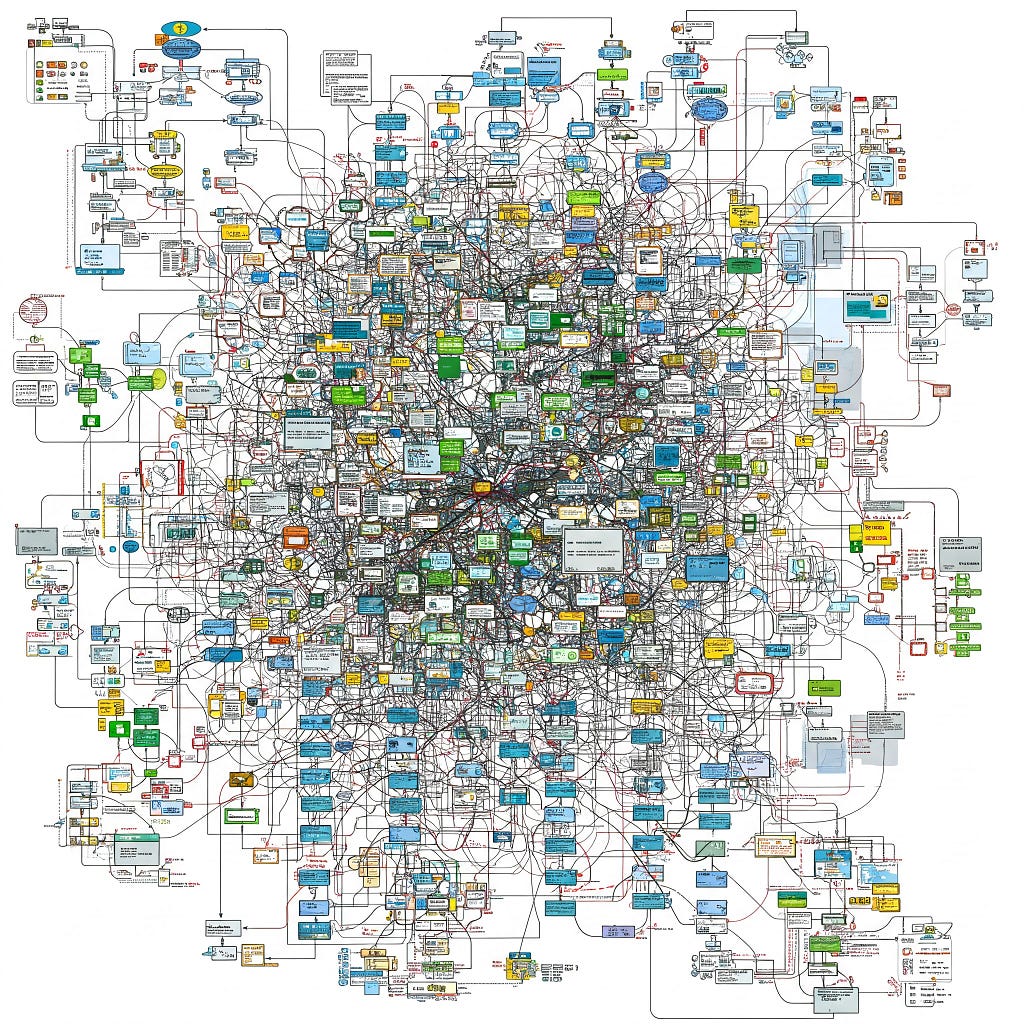
The rise of “no-code” and “low-code” platforms promising to democratize automation has brought with it a familiar sight: sleek user interfaces showcasing intricate visual workflows. You start with a…
The rise of “no-code” and “low-code” platforms promising to democratize automation has brought with it a familiar sight: sleek user interfaces showcasing intricate visual workflows. You start with a blank canvas, drag and drop boxes representing steps — data retrieval, conditional logic, loops — and connect them with lines, building a seemingly intuitive representation of your business process. Companies like Writer and countless startups are touting these visually sophisticated tools, showcasing complex workflows as proof of their power and flexibility.
But at HyperTrail, we see this as a fundamentally flawed approach to empowering enterprises with AI. While these visual representations might look appealing in a demo, they often mask an underlying complexity that hinders scalability and maintainability in real-world enterprise environments.
Think about it: an average enterprise with hundreds of white-collar employees potentially creating workflows five days a week. This quickly translates into a massive, unorganized sprawl of highly intricate visual diagrams. If you weren’t the one who built a particular workflow, deciphering its logic can be a daunting task, akin to a developer trying to understand a sprawling, undocumented codebase.
Beyond a certain level of complexity, these visual workflows cease to be intuitive. They become a visual engineering project, attempting to translate the nuanced and often unpredictable reality of human work into rigid, linear “if this, then that” logic. This isn’t how most people actually operate. We don’t inherently think in terms of complex branching diagrams.
The persistent lack of widespread adoption of these visual workflow tools across enterprises speaks volumes. Despite decades of existence, they haven’t become the ubiquitous solution for business process automation. While they might be used for documenting processes during project execution, these diagrams often end up gathering digital dust on a SharePoint server, rarely revisited or maintained. The sheer effort of updating hundreds of interconnected workflows as business needs evolve makes them practically unsustainable.
Visual workflows, we believe, are the wrong abstraction for solving complex enterprise challenges. Yet, they remain the dominant paradigm, perhaps because they appeal to an engineering mindset trying to convince non-technical users with a visually palatable interface layered on top of what is essentially code logic. But a technical UI is still a technical solution, and for many users, it carries the same cognitive burden as code itself.
Our approach at HyperTrail is radically different. Through hundreds of in-depth discussions with enterprises in the hospitality space, we’ve identified a fundamental pattern in how business users describe their needs. They don’t articulate intricate, multi-step workflows. Instead, they describe situations or events and their desired outcomes in a straight line.
For example, a business user might say: “When a customer on our website encounters an error and then calls customer service, I want the agent to see the website error so they can react effectively.” Or, “When a customer calls customer service and they’re unsure about their issue, I want the agent to have a consolidated view of their data to personalize the interaction.”
These are event-outcome pairs, simple and direct. Business stakeholders can articulate hundreds of these without delving into the granular details of a visual workflow. While you might be able to coax them into agreeing on a detailed process map, that process is likely to change within weeks, requiring a cumbersome revalidation effort. An event and a desired outcome, however, tend to be more timeless and universally true for the business. As Jeff Bezos famously said, no customer ever asked to pay more or receive slower delivery. Similarly, core business outcomes remain relatively constant.
Designing a system to react to an event and deliver a specific outcome for that event is inherently simpler and more resilient than building sprawling visual workflows. Each event-outcome pair represents a manageable, isolated case. In the context of an enterprise with millions of customers and hundreds of systems, this modularity is crucial. Trying to build a single, monolithic visual workflow encompassing all possible permutations is an engineering-centric approach that doesn’t align with how businesses actually function.
At HyperTrail, we’ve embraced this event-outcome paradigm. Our “trails” represent these direct pathways. In the user interface, they are presented as a straightforward connection between an event and an AI agent taking a specific action to achieve a defined outcome. You define a simple case — an event occurring in your system — add relevant data and AI intelligence, and specify the desired outcome.
This approach is inherently scalable, not just technically, but also organizationally. Large enterprises are structured into departments and business units for a reason: to divide complex problems into manageable chunks with clear responsibilities. HyperTrail aligns with this structure. You can create thousands of trails, organized by organizational unit, with clear ownership and accountability for the outcomes. While these trails might reuse the same underlying systems and actions, the logic within each trail, driving the AI agent to achieve a specific business outcome, belongs to the relevant team.
By organizing trails within a hierarchical structure mirroring the company’s organizational chart, teams across the enterprise understand their responsibilities and manage their specific automation efforts independently. Because each trail is a direct line from event to outcome, the system remains transparent and maintainable.
In summary, visual workflows fail because they are a thinly veiled attempt by engineers to make complex logic appear non-technical. They become unwieldy, difficult to understand and maintain, and don’t reflect how businesses actually operate. The effort required to build and maintain them at enterprise scale often outweighs the benefits.
The failure of the data warehouse abstraction and the rise of the data lake was precisely due to the inability of every business unit to agree on a single, monolithic data structure upfront. Similarly, the failures of overly ambitious CDP projects often stem from trying to create a single, all-encompassing platform across disparate organizational silos.
HyperTrail’s event-outcome approach, structured around organizational units and empowering teams to act independently within the context of the broader enterprise, is a more natural fit for modern business practices. It aligns with how leaders structure their organizations for effectiveness and offers a more scalable and maintainable way to leverage the transformative power of agentic AI. We believe this is the right path forward, moving beyond the beautiful lie of overly complex visual workflows.