Why the Future Demands a Central Nervous System for the Enterprise
For the past fifteen years immersed in the world of system architecture and design, I’ve consistently found myself drawn to the elegant efficiency of the human body. Its self-healing capabilities,…
For the past fifteen years immersed in the world of system architecture and design, I’ve consistently found myself drawn to the elegant efficiency of the human body. Its self-healing capabilities, remarkable resilience, and optimized energy consumption serve as a profound source of inspiration. It’s worth remembering that even the earliest AI models drew inspiration from the human nervous system. I hold a strong conviction that as our systems become increasingly sophisticated, they will inevitably mirror the intricate complexity of our own biology.
Consider the typical enterprise IT landscape today. It’s often a patchwork of disparate solutions, each acquired opportunistically from various market players, the established giants, the cloud behemoths, and a host of others. Each piece of software was originally conceived to address a specific need at a particular moment in time. Over the years, these systems have evolved, shaped by market dynamics and external pressures, but rarely driven by a holistic vision of the enterprise itself.
Look at the common components: data lakes or lakehouses, ERP and HR systems, websites, CRM platforms, marketing tools, and, for some, the often-siloed Customer Data Platform. Then, layered on top, are industry-specific proprietary systems, passenger service systems for airlines, property management systems for hotels, PLM for manufacturing. These systems, by and large, were never designed to interoperate seamlessly. Connectors were often afterthoughts, built reactively to address customer demands for integration with a handful of dominant players.
The result? An IT ecosystem that resembles a collection of independent organs, tenuously connected by a trillion-dollar system integration market. Companies spend vast sums to build bespoke integrations between System A and System B, integrations that are often brittle, purpose-specific, and consume significant resources that could otherwise be directed towards customer value.
My six years deeply involved in digital transformation, particularly within travel and hospitality, have reinforced this reality. I have yet to encounter a single company whose IT architecture aligns perfectly with their strategic aspirations. The prevailing model often involves a microservices platform (a mix of “as-a-Service” and self-built components), a data platform (encompassing data lakes and tiered quality zones), and various AI models orchestrated to act on behalf of the business. While this represents a step forward, it’s still a far cry from the truly integrated and responsive enterprise of the future.
In fact, our work at HyperTrail has led us to believe that even this “future vision” is merely an intermediate stage. It’s still constrained by constructs born from technology itself, microservices as platforms, off-the-shelf software, and data lakes with their inherent limitations in real-time personalization. The notion of driving conversations often remains rooted in pre-LLM paradigms.
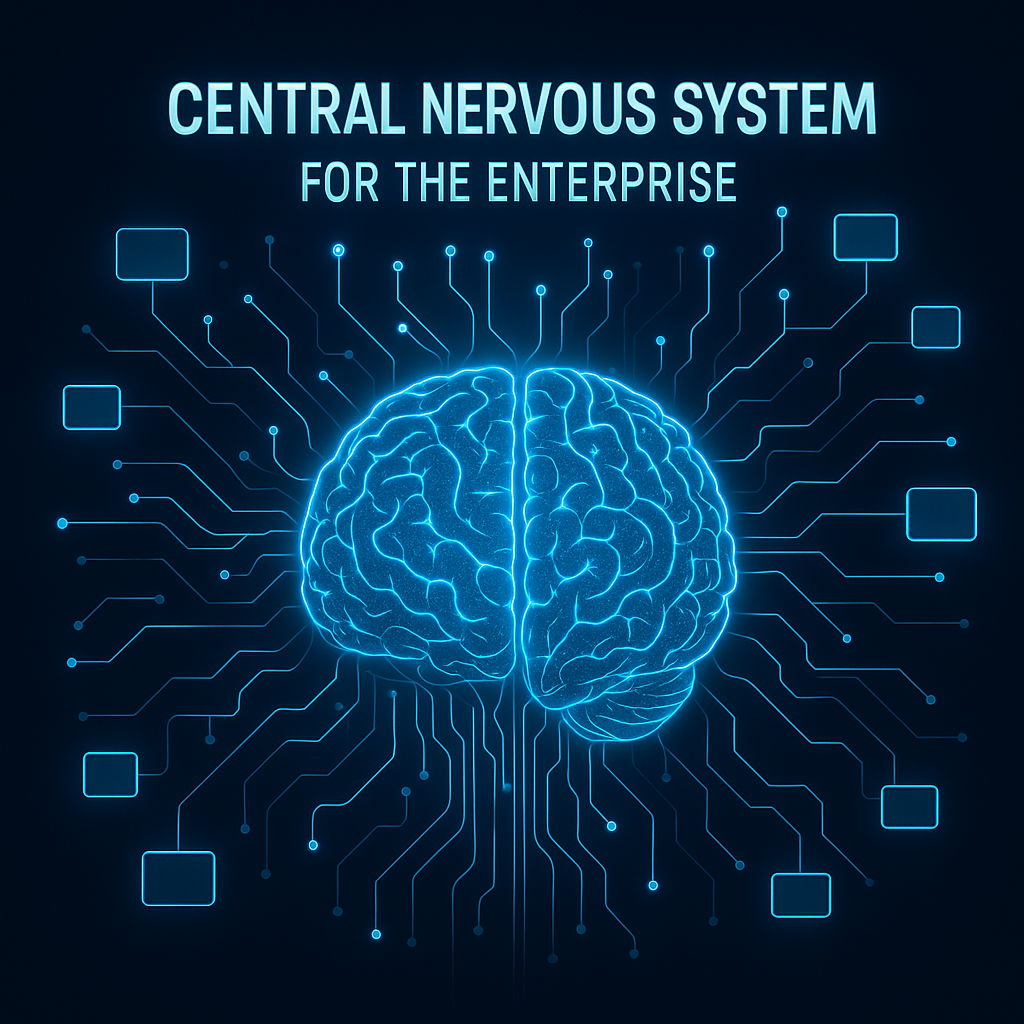
Instead, we envision an enterprise landscape that more closely resembles the human body’s central nervous system. Think of the constant stream of diverse sensory inputs, touch, smell, sight, taste, processed in real-time. Information flows to both local, fast-acting decision centers and more centralized, long-term reflexive processing areas within the brain. Even immediate reactions are often localized. This mirrors the evolving architecture of robotics, where fast, reflexive actions coexist with higher-level, more intelligent decision-making.
Applying this analogy to the enterprise, we envision a future where companies are acutely aware of the trillions of events occurring constantly, website clicks, mobile app interactions, critical customer service calls, supply chain disruptions, system outages, even employee absences. Just as the human body filters signal from noise, the enterprise needs to intelligently process this event stream.
Imagine an enterprise where events trigger localized and centralized decision-making processes, informed by specific operational context. The system reacts uniquely and in real-time based on the company’s accumulated knowledge, its customer relationships, and the expertise of its workforce. Picture a system that can instantly assess a long queue at a venue, check staffing levels, and proactively alert a manager, all triggered by a real-time event. This level of granular control and responsiveness across every facet of the business is our ultimate goal.
We see AI as the new fundamental building block in enterprise technolog, the core of this “enterprise nervous system.” While the concept of an enterprise nervous system isn’t entirely new, the technological capabilities to realize it have only recently become viable. The challenge has always been building a business-specific decision-making engine that can react intelligently to the vast array of situations an enterprise faces daily. Pre-LLM business rules engines were often rigid and difficult to adapt.
The advent of powerful large language models changes everything. Now, an event can be processed in the rich context of the company, augmented by real-time information retrieval, leading to informed, real-time actions. This can happen at the scale of thousands of transactions per second.
Our vision for HyperTrail is to create this enterprise “central nervous system” enabling travel and hospitality companies to operate in true symbiosis with their environment, reacting to events in a highly specific and adaptable manner. We’ve even seen early glimpses of this self-healing capability in our AI-powered connectors, which can automatically identify and resolve errors like missing fields, mimicking the human body’s ability to repair itself.
We envision a future where enterprise leaders can move beyond the endless cycle of software procurement and integration, instead cultivating an organic, intelligent system that can be influenced by their expertise and customer relationships. This will finally allow businesses to differentiate themselves not just by the technology they buy, but by the unique and agile way they operate. We are incredibly excited about this vision and look forward to seeing what our users will build with HyperTrail.
Learn more on how we are building the future of enterprise IT for Travel and Hospitality companies HyperTrail.ai.