AI sessions are the new file
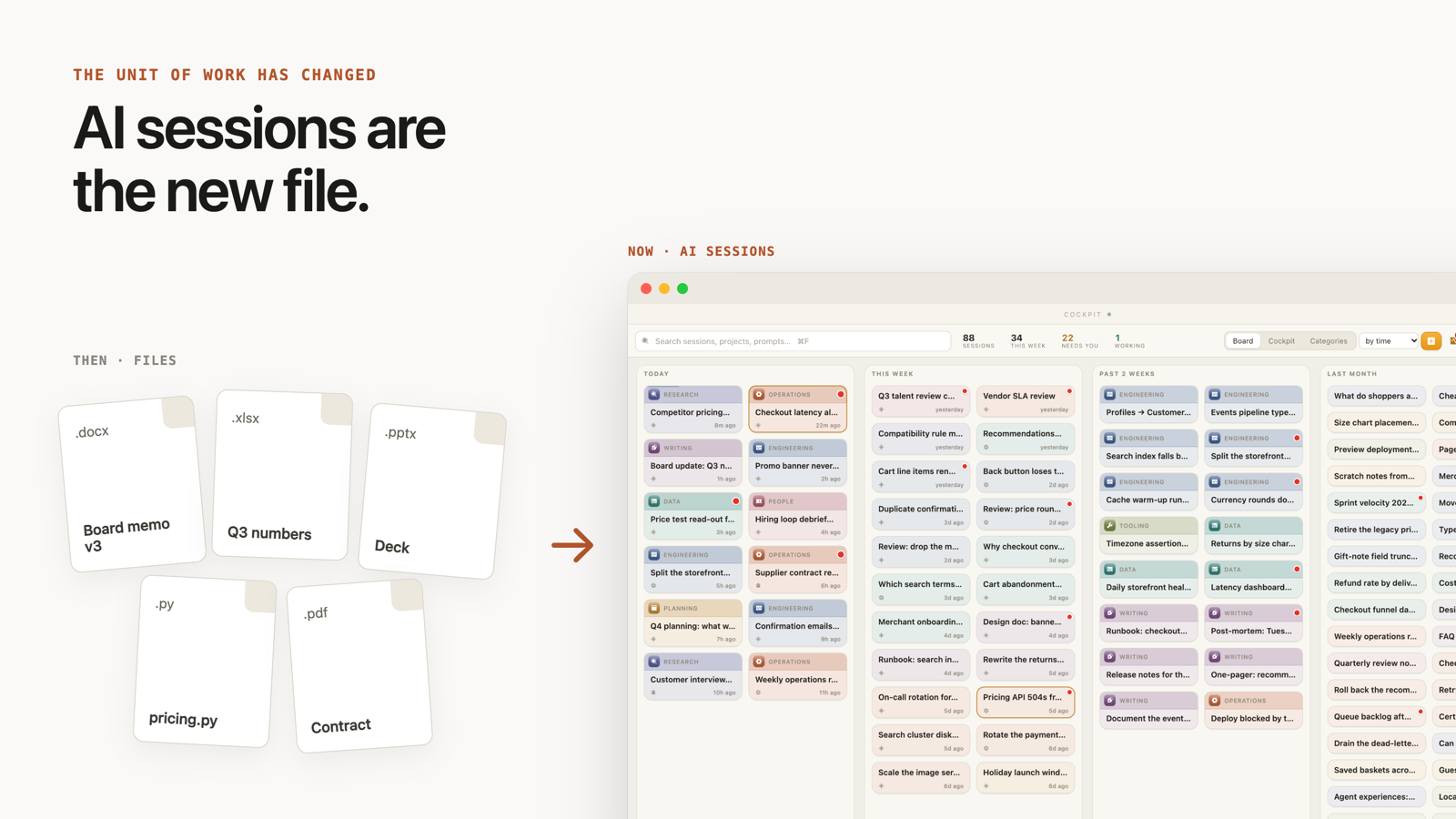
For forty years the file was the unit of work, and every productivity tool was built around it. In the age of agents, work starts as a conversation with Claude Code or Codex. The AI session is the new file, and it needs tools built around it.
Look at what's open on your screen right now and count the files.
For most of the history of personal computing, that was the whole answer. A document. A spreadsheet. A deck. A folder of code. We gave them names, put them in folders, emailed them to each other, and argued about which version was final. The file was the unit of work, and almost every tool we built followed from it.
The desktop metaphor that Xerox and then Apple made famous was literally a desk covered in documents and folders. The word processor opens one file at a time. The IDE is a window onto a tree of files. Dropbox and Google Drive sync files. Version control tracks changes to files. Even "the cloud", for most people, became somewhere to keep their files.
That model is quietly breaking.
Work now starts as a conversation
Think about how a piece of work actually begins in 2026.
"Draft the Q3 board update from the finance export and last quarter's deck." "Find out why checkout conversion dipped in week 36." "Scan these twelve competitors for price changes on our top 200 products." "Fix the alarm that keeps firing on checkout at 2am."
Each of those starts a session with an agent such as Claude Code, Codex or Kiro. The agent reads things, runs things, asks you a question or two, and writes things. A memo appears. A spreadsheet. A chart. A pull request.
Those outputs are still files. But they're no longer where the work lives. They're what the work left behind.
If you want to know why the board memo says what it says, the file can't tell you. If you want to know what's still open, what the agent is waiting on, or what it tried before landing on this version, none of that is in the file either. It's in the session.
What a session holds that a file never did
A file is a snapshot of content. A session is a record of work, and it holds four things a file never could.
1. The intent. What you asked for, in your own words. Six weeks later, "Retire the legacy pricing client, but nothing gets removed until every caller is on the new API" tells you more than any filename ever will.
2. The state. A file is just there. A session is working, waiting on you, done, or stuck on a usage limit until 11:54. State is what tells you where to spend your next ten minutes.
3. The history. Every step, every command, every version of every document it touched, in order. A file has a modified date. A session has a story.
4. A collaborator. You can't ask a file a question. You can ask a session. You can comment on one line of the draft and have the agent revise it. You can ask what a number means without interrupting the work. You can say "keep going".
A file is a noun. A session is a verb.
Our tools are still built for files
Here's the mismatch. Most of us now run dozens of these sessions a week, and some of us run dozens a day. Yet the tools we use to manage them were designed for the previous unit of work.
Sessions live in terminal tabs that vanish when you close them, in a sidebar sorted by date, or in a folder of transcript files nobody opens. Finding the session where you looked at a competitor's prices last Tuesday means remembering which tab, which project, which tool. Knowing which four of your thirty sessions are waiting on an answer means opening all thirty.
It's as if we'd invented the document but were still managing our work with a list of keystrokes.
Every time the unit of work changed, a new kind of tool followed. Files and folders got the desktop and the file manager. Source code got the IDE. Shared documents got Google Docs and Notion. AI sessions need their equivalent: a place built around the session itself, not around the files it produces.
What a session-first tool looks like
If the session is the building block, a few things follow.
- You see work, not folders. Every session on one board: what it's about, how recent it is, and which ones are waiting on you.
- You open a session the way you used to open a document. The conversation and everything it produced sit side by side: the memo, the table, the PDF, the dashboard it built.
- You review the way you'd review a colleague. Select a sentence and comment on it, and the agent that wrote it revises it. Ask what a passage means without derailing the work.
- You find things by what was said, not where they were saved. A competitor's name, a ticket number or a figure from a table finds the session it came from.
- You start work by starting a session. A new to-do isn't a blank document; it's an instruction, with an agent already on it.
- It lives where the agents live. Claude Code, Codex and Kiro run on your machine, next to your files, your terminal and your company's tools. The tool that organises their work belongs on the same machine, not in another web app that wants a copy of everything.
Why we built Cockpit
At Hypertrail we hit this wall ourselves. By one Friday we had about ninety AI sessions going: a board update half drafted, a price test read-out, a hiring debrief, two production fixes, and a competitor scan we'd forgotten we started. Four of them were waiting on us, and we couldn't tell which four.
So we built Cockpit, a free native Mac app that treats the AI session as the unit of work. It reads the sessions Claude Code, Codex and Kiro already write to your Mac and turns them into one workspace. The board shows your work and what needs you. Opening a session shows the documents it produced. You can search everything said in every session, and start new sessions from the same place. It runs locally, with no account and no server, because your sessions are your work.
We've shipped fourteen versions in two weeks, and the thing we've learned is that this shift is bigger than any one feature. Once you start treating sessions as the building block, everything else gets rearranged around them: how you plan the day, how you review, how you hand work to a teammate, and how you find something from last month.
The next forty years
Files aren't going away. Neither did paper when the file arrived. But the file is no longer the most important object on your computer. The session is: the place where intent, state, history and a collaborator all live together.
The tools that win the next decade of knowledge work will be the ones that understand that. We think it starts with a simple question: what would your computer look like if it were built around your AI sessions instead of your files?
That's what we're building. You can try it at aidash.dev.